
Mental game · 4 min read
Choose One Final Cueing Thought Before a Pool Shot
A final cueing thought is one brief action phrase selected before the player bends into the shot. It is not a last-second lesson or a stack of corrections. The test below turns a repeated delivery error into one candidate cue, holds the layout constant and scores three process events separately from the pot. Keep the cue only when its target process improves without disrupting the rest of the routine.
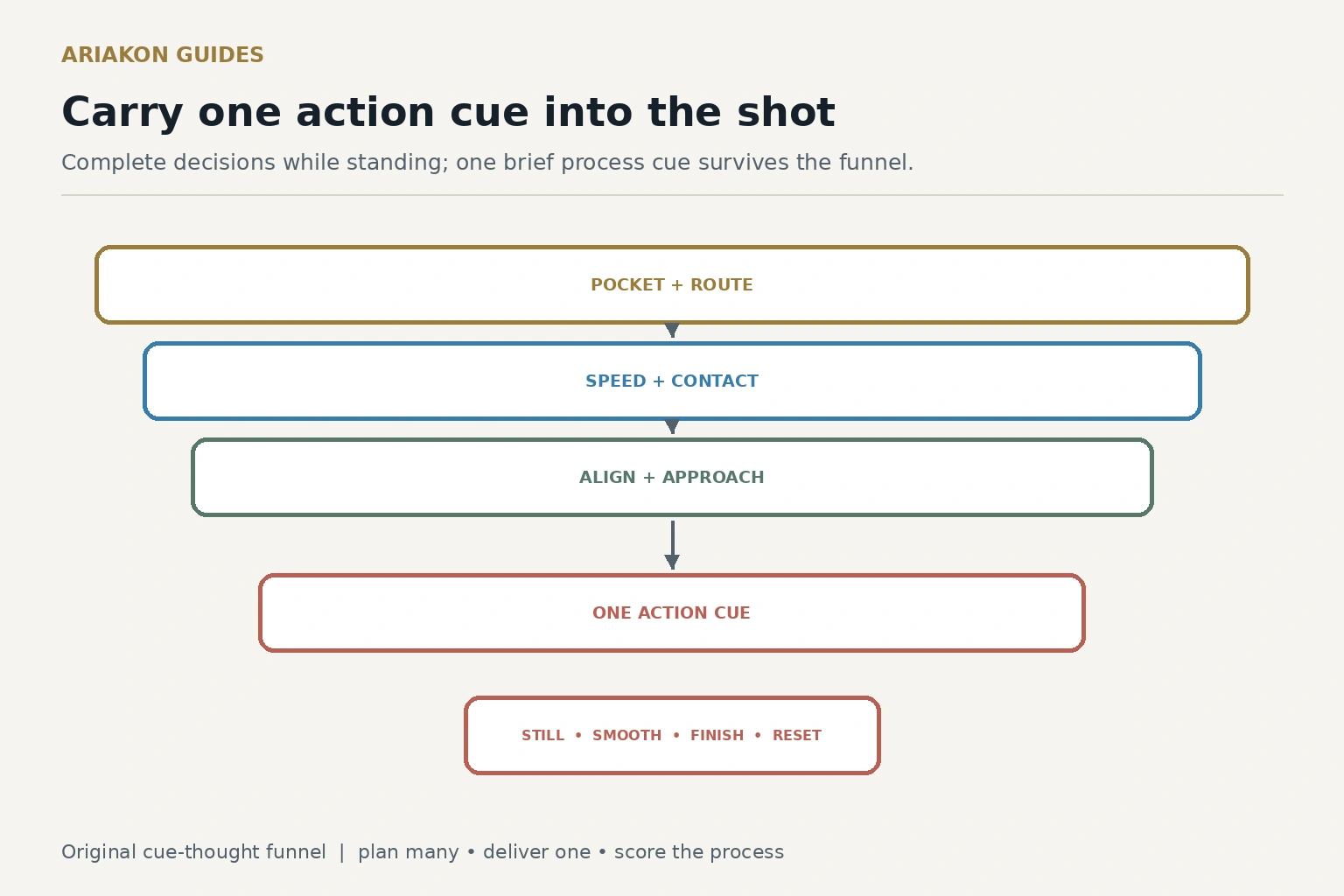
Finish decisions before the action cue
Choose pocket, cue-ball route, speed and contact while standing. Confirm the picture during the approach. After the bridge lands, use only the selected action cue. If the picture changes, stand up and restart rather than adding another sentence while down.
A useful cue is short, controllable and tied to visible evidence: STILL for early head or bridge movement, SMOOTH for a lunge, FINISH for an early grab, or RESET for steering after doubt. An outcome warning such as do not miss is not an action. No repeated process problem means the correct candidate may be no cue.
Build a repeatable pre-shot routine before testing where one final cue belongs.
Use visualization as a separate measured skill when the problem is the shot picture rather than delivery.
Choose one cue from observed evidence
This is an original within-player comparison of one attention cue. It does not establish one phrase as correct for every player or present an unverified institutional recommendation. Record the exact behavior you expect the phrase to change before testing it.
| Repeated evidence | Candidate | Visible pass |
|---|---|---|
| head or bridge moves before contact | STILL | body remains quiet through contact |
| final stroke visibly lunges | SMOOTH | acceleration continues without a late jab |
| cue is grabbed or stopped early | FINISH | cue comes to rest naturally on line |
| aim is steered after settling | RESET | player stands instead of correcting while down |
| no stable repeated error | NO CUE | ordinary routine continues unchanged |
Mark one exact two-layout station
Use table-diamond coordinates with head-left pocket (0,0), foot-right pocket (8,4), x along table length and y across width. Straight layout S: object-ball center (6,3), cue-ball center (4,2), called foot-right pocket (8,4); the three centers are collinear. Mild-cut layout C: keep object ball (6,3) and pocket (8,4), but place cue ball at (4,1.5). Use center-ball contact and a speed that leaves the cue ball within one diamond of the object-ball start after contact.
Mark centers with removable reinforcements approved for the practice surface. Reset exact centers, use the same balls and pocket, and video from the same safe angle or use one observer who scores only the named process.
Run four blocks of six shots
Say the cue once, silently or softly, after the final standing picture and before the last warm-up stroke. Do not chant it during delivery. If speaking changes timing, read it from a card outside the shot line before approaching.
| Block | Layout | Cue use | Purpose |
|---|---|---|---|
| 1 | S | no cue | six-shot baseline |
| 2 | S | candidate cue | matched six-shot comparison |
| 3 | S | alternate cue / no cue | check immediate repeatability |
| 4 | C | candidate cue | mild transfer test |
Score process separately from pocketing
Each six-shot block has a maximum of 18 process points and 6 pot points, 24 total. Across all 24 attempts the maximum is 72 process points plus 24 pot points, 96 total. Compare process subscores first; the total cannot show whether the cue changed its target behavior.
Worked example: baseline 13/18 process and 5/6 pots; cue block 17/18 process and 5/6 pots. Alternating block shows 9/9 process on the three cue trials and 7/9 on the three no-cue trials. The mild-cut cue block scores 15/18 process and 4/6 pots. The cue earns a three-session trial because its target process improved while potting held in the matched block; the lower transfer pot score remains a practice note, not a hidden success.
| Point | Pass evidence |
|---|---|
| 1 — chosen early | one cue or no cue declared while standing |
| 1 — no additions | no extra technical instruction added while down |
| 1 — target process | named visible behavior passes |
| 1 — called pot | object ball reaches the called pocket |
Keep, replace or remove the cue
Transfer to ordinary play by marking CUE, NO CUE or RESET before each shot for three practice racks. Score one point only when the choice is made standing and followed without adding a second thought. The phrase remains a temporary process tool, not an identity or a promise.
| Pattern | Decision |
|---|---|
| target process rises; potting holds | keep for three sessions, then retest without prompting |
| process rises; potting falls sharply | check whether attention displaced aim or speed |
| pots rise; target process does not | repeat; do not credit the cue yet |
| both decline | remove cue and rediagnose |
| no reliable difference | use no final cue unless reset discipline improves |